You’re about to commit $10,000 to $20,000 to technology bolted to your roof. The question of how long it lasts isn’t idle curiosity; it determines your payback period, your savings timeline, and whether you’re making a sound investment or an expensive one.
Solar panels don’t fail like a blown fuse. They degrade slowly, losing a fraction of output each year until the system no longer makes financial sense to run. The gap between a 20-year system and a 35-year system comes down to four controllable variables: panel quality, installation, climate, and maintenance.
This guide breaks down exactly how long solar panels last by type, what degrades them, what warranties actually guarantee, and how to identify the right moment to replace.
Table of Contents
- The Short Answer
- What Is Solar Panel Degradation?
- Solar Panel Lifespan by Type
- Factors That Affect How Long Solar Panels Last
- What Solar Panel Warranties Actually Cover
- Signs Your Panels Are Underperforming
- Replace or Keep: How to Decide
- How to Extend Your Solar Panel Lifespan
- Conclusion
1. The Short Answer
Most solar panels last between 25 and 35 years before output drops to a level where replacement makes economic sense. They don’t stop producing electricity at that point; they just generate noticeably less of it.
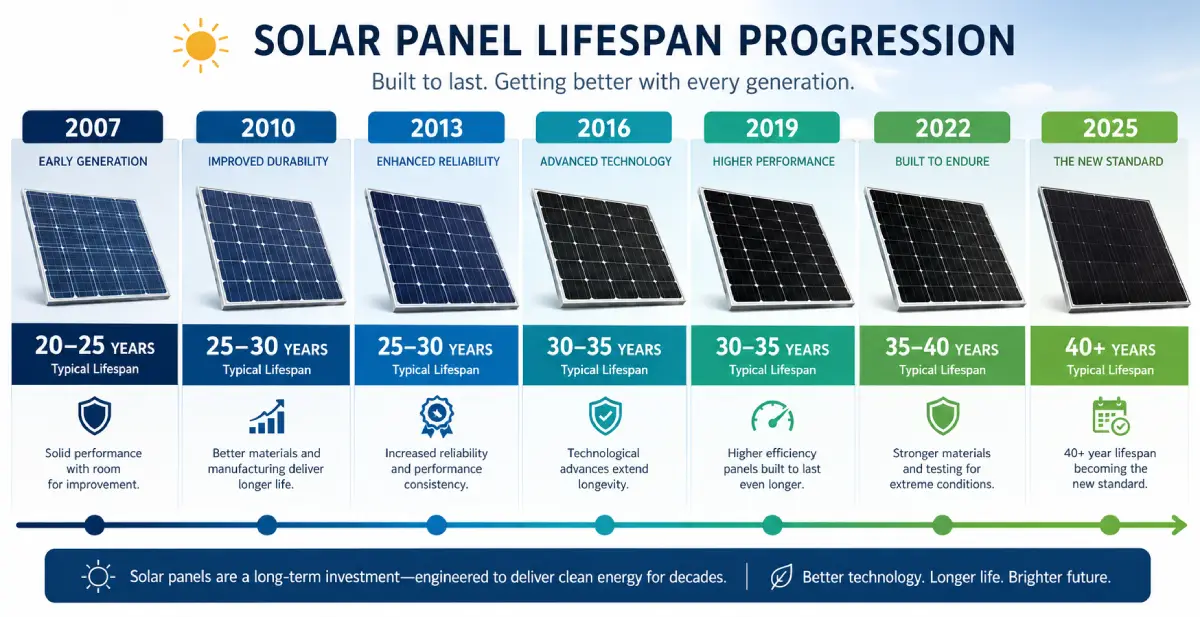
According to the U.S. Department of Energy, a Berkeley Lab survey of solar industry professionals found that the average operational lifespan of a solar panel increased from around 20 years in 2007 to 25–35 years in 2025.
That upward shift reflects genuine advances in materials science, manufacturing tolerances, and coating technology. Panels built today are measurably more durable than those installed a decade ago.
2. What Is Solar Panel Degradation?
Degradation is the gradual decline in a panel’s ability to convert sunlight into electricity. UV exposure, thermal cycling (heating and cooling daily), humidity ingress, and physical weathering all erode panel performance across years of outdoor operation.
The industry-standard degradation rate sits between 0.5% and 1% per year. At 0.5% annual degradation, a 400W panel on day one produces around 350W after 25 years. That’s 87.5% of original capacity, still delivering meaningful output.
Premium monocrystalline panels from top-tier manufacturers now achieve rates as low as 0.25% per year. At that rate, the same panel operates above 93% of its original capacity after 25 years.
The first year typically sees a slightly steeper drop called Light-Induced Degradation (LID), where initial sunlight exposure stabilises the silicon cells. After that initial settling, the decline becomes gradual and predictable.
3. Solar Panel Lifespan by Type
Not all panels age equally. The technology inside determines both degradation speed and economic lifespan.
| Panel Type | Typical Lifespan | Annual Degradation Rate | Efficiency Range | Standard Warranty |
| Monocrystalline | 30–35 years | 0.25%–0.50% | 17%–22% | 25–30 years |
| Polycrystalline | 25–30 years | 0.50%–0.70% | 15%–17% | 25 years |
| Thin-Film (CdTe) | 10–20 years | 0.50%–1.00% | 10%–13% | 10–20 years |
| Thin-Film (CIGS) | 15–25 years | 0.50%–1.00% | 12%–15% | 10–25 years |
Monocrystalline panels dominate residential rooftop installations for good reason. The higher upfront cost is offset by superior longevity and efficiency, making the total cost-per-kWh across a 30-year lifespan substantially lower than cheaper alternatives.
Thin-film panels suit specific commercial or utility-scale applications where low upfront cost per square metre matters more than longevity. For Australian residential rooftops, thin-film is rarely the financially rational choice.
4. Factors That Affect How Long Solar Panels Last
Panel Quality and Manufacturing Tier
Tier 1 panels from established manufacturers undergo independent testing and use consistent, quality-controlled materials. Tier 2 and Tier 3 panels cut corners on cell quality, encapsulant materials, and junction box sealing. Those compromises show up as accelerated degradation within 5 to 10 years.
Buying on price alone is the single most common mistake Australian solar buyers make. A $500 saving on cheaper panels can translate to thousands in lost energy production and premature replacement costs.
Installation Quality
A poor installation creates micro-cracks in cells, compromises weatherproofing, and introduces electrical faults from day one. These problems don’t appear immediately; they compound silently across years of thermal expansion and contraction.
Choose a Clean Energy Council (CEC) accredited installer. They must meet Australian Standards for mounting, wiring, and system design. If you are based in Western Australia, companies like Solar Installation Perth.com specialise in local conditions, including the high UV exposure and heat stress common across the Perth metro area.
Climate and Local Environment
Heat accelerates degradation. Panels in Queensland or Western Australia face greater thermal stress than those in Victoria or Tasmania. The sunniest states generate the most power but also wear panels down faster, a trade-off worth factoring into system specifications.
Coastal installations face additional corrosion risk from salt-laden air. Panels within approximately two kilometres of the coast need frames, mounting hardware, and junction boxes rated for marine environments. Standard residential-grade hardware corrodes faster in salt air.
Maintenance and Inspection Regularity
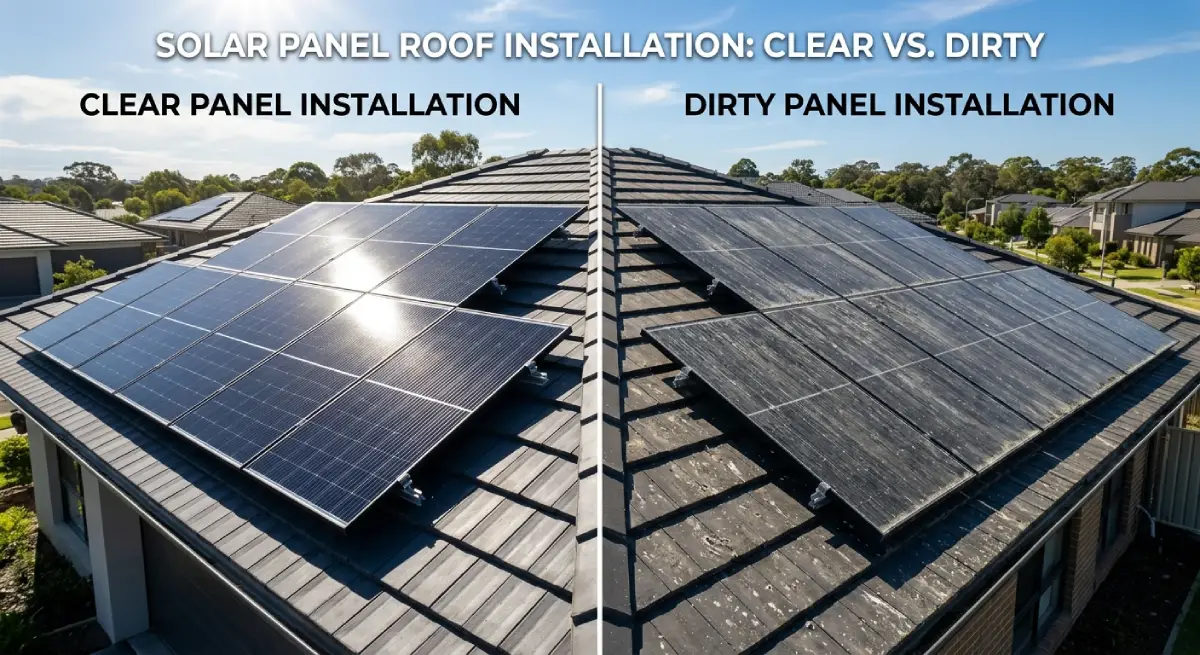
Dust, bird droppings, and leaf debris reduce output, but the more serious risk is undetected moisture ingress through a degraded junction box seal or cracked backsheet. Left undetected, moisture inside a panel causes irreversible cell damage.
An annual inspection by a qualified solar electrician catches developing issues before they cascade. This single habit is the clearest differentiator between systems that hit 35 years and those that plateau at 20.
5. What Solar Panel Warranties Actually Cover
Solar panels carry two separate warranties. Conflating them leads to coverage surprises at exactly the wrong time.
Product Warranty (Equipment Warranty): Covers manufacturing defects, material failure, and workmanship. Standard coverage runs 10 to 12 years for most brands. Premium manufacturers now offer 25-year product warranties; that’s the benchmark worth chasing.
Performance Warranty: Guarantees a minimum output percentage across the panel’s stated lifespan. The industry standard guarantees at least 80% of rated output after 25 years. Better manufacturers guarantee 86% to 92% at year 25, which is meaningfully different in cumulative energy terms.
Read the performance warranty degradation schedule beyond the headline number. Some manufacturers hit 80% at year 25 by allowing a steep early drop followed by a slower decline. Others hold output flat for longer before a final reduction. The curve matters as much as the endpoint.
Installer Workmanship Warranty: This covers the installation itself, separate from the panel manufacturer. Australian Consumer Law provides baseline protections, but an explicit 5- to 10-year installer warranty gives you clearer recourse if mounting or wiring faults surface later.
6. Signs Your Panels Are Underperforming
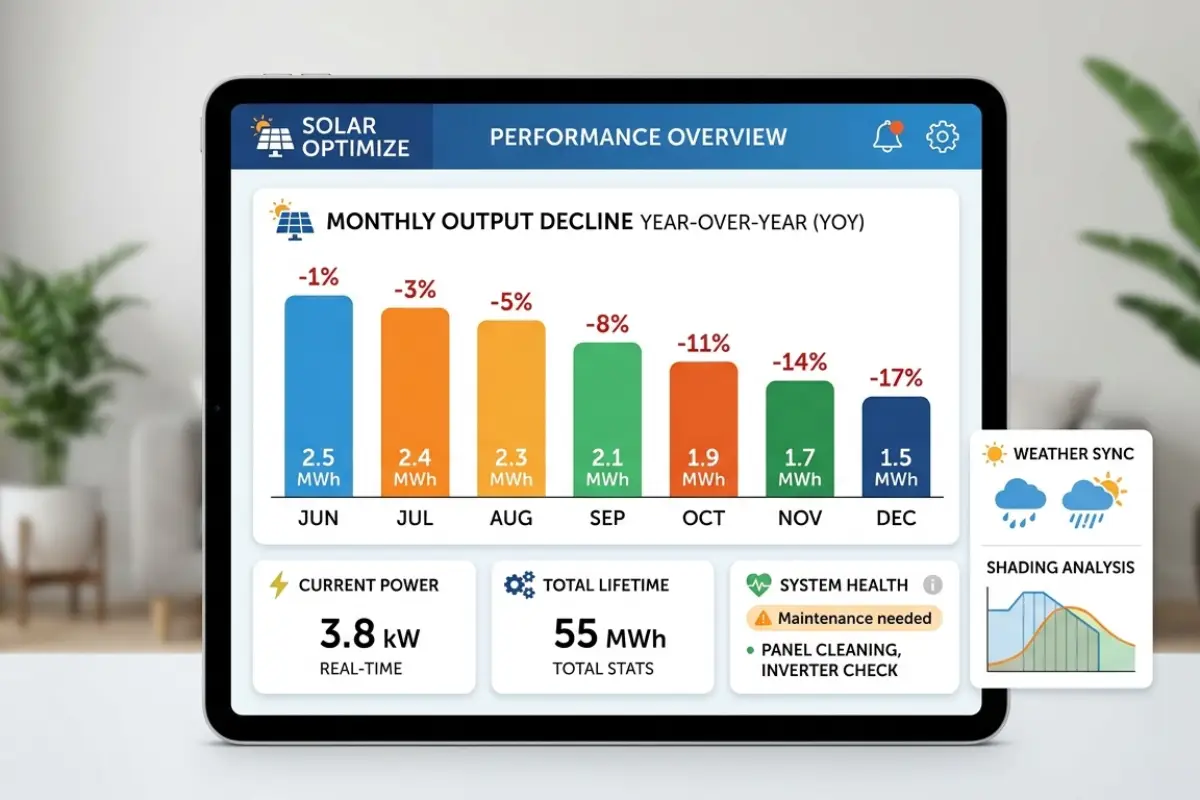
Output naturally declines with degradation, but a sudden or steep drop signals a specific problem requiring investigation.
Year-on-year output drop exceeding 5%: Account for seasonal and weather variation by comparing the same months across years. A drop beyond normal degradation rates in comparable conditions warrants a professional inspection.
Hot spots detected on panels: Infrared thermal imaging, used by qualified solar inspectors, identifies hot spots caused by cell damage, bypass diode failure, or localised soiling. Hot spots concentrate heat in specific cells and accelerate degradation at those points sharply.
Persistent inverter fault codes: Your inverter monitors string and panel-level performance. Error codes related to low input voltage, ground faults, or insulation resistance faults can indicate panel-level deterioration, not just inverter issues.
Visible physical damage: Delamination (bubbling of the surface laminate), backsheet yellowing, microcracks visible as spider-web patterns across cells, or cracked glass all indicate advanced degradation or physical damage that won’t self-correct.
7. Replace or Keep: How to Decide
The 25-year mark is not an automatic replacement trigger. The decision is economic, not chronological.
Compare your system’s current annual output (from monitoring data or bill analysis) against what a correctly sized new system would produce. Divide the cost of a full system replacement by the annual energy value gain to calculate a payback period on the upgrade. If that payback period exceeds 10 years, keeping the existing system running is often the better financial call.
If your panels still produce above 75% of rated output, your inverter is functioning, and your roof structure is sound, replacement is hard to justify on economics alone. The calculation shifts if your household energy consumption has grown substantially beyond what the original system covers, or if a battery storage addition triggers a full system reassessment.
The replacement calculus shifts materially when sustained rises in electricity prices increase the annual energy value of a higher-output system, shortening the payback period on an upgrade.
Older systems installed before 2015 frequently used string inverters with a 10- to 15-year functional lifespan. Inverter failure on an aging system is often the practical trigger for a full upgrade assessment, since replacing an inverter alone on panels that are 15 years old may not deliver the best return compared to a complete system overhaul.
8. How to Extend Your Solar Panel Lifespan
Schedule an annual professional inspection. A qualified solar electrician checks connections, seals, mounting integrity, and panel-level performance. The cost of $150 to $300 per inspection is trivial against the cost of premature system failure.
Clean panels seasonally in dusty conditions. Rainfall handles basic cleaning in most Australian climates. In inland or agricultural areas where dust accumulates heavily, manual cleaning twice yearly restores output. Use only soft brushes and plain water; abrasive materials scratch the anti-reflective coating and cause long-term efficiency loss.
Install a real-time monitoring system. Modern inverters include monitoring apps as standard. Real-time monitoring catches output drops the day they occur rather than months later when reviewing electricity bills. Early detection prevents small problems from becoming irreversible ones.
Manage shading from vegetation growth. Trees grow, and new construction creates shadows that didn’t exist at installation. With older string inverter systems, a single shaded cell reduces the output of the entire string it belongs to. Trimming vegetation around panels is a low-cost, high-return maintenance task.
Specify quality hardware from day one. No retrofit corrects a cheap panel. The most consequential lifespan decision is choosing Tier 1 panels with a low degradation rate and a long performance warranty. That decision happens before the first panel reaches your roof, and its effects compound across decades.
Conclusion
Most solar panels last 25 to 35 years, with premium monocrystalline panels consistently reaching the upper end of that range as degradation rates drop below 0.5% per year. Panel type, installation quality, climate exposure, and maintenance discipline are the four variables that separate a 20-year system from a 35-year one. Get those four right, and the investment case for solar strengthens considerably across the system’s full productive life.